Wednesday, 7 March 2018

What is a lateral lisp?


A lateral lisp is a type of functional speech disorder, where a child or adult has difficulty producing specific sounds.

Terminology

The term “lisp” is not typically used by speech and language therapists as it is not very specific - there are actually four different types of lisp as well as all the other speech sound errors. Instead we may say “lateralisation of s” or “s articulation difficulties” depending on what the error is.

What is a lateral lisp?

As mentioned, a lateral lisp is a type of functional speech disorder. Unlike some other lisps, Lateral lisps are not found in typical speech development. The tongue position for a lateral lisp allows the air to flow over the sides of the tongue instead of over the front. This is the reason this sort of lisp is sometimes referred to as a 'slushy lisp'.

Causes

There is no known cause of a lisp. However, some professionals suggest that excessive or long-term use of dummies could be a contributing factor. This is not the case for all, as some children who have never used a dummy still go on to develop a lisp.

Treatment

There are many different ways to work on Lateralised sounds, depending on what the sounds are.  Typically it will include listening activities, production of the sound in isolation (the sound alone) progressing onto words and sentences.


Sophie Harding
Speech and Language Therapist


Sunday, 4 March 2018

But she looks fine when she's here!


How many times have I heard this yet the parents KNOW their child is anxious?! Maybe they've had to drag them kicking and screaming into school, maybe the child has tried to self harm or attacks their parents on a regular basis. I saw this on twitter and it sums up how anxiety is not one thing. We don't always see it. A child can mask: hide their issues at school but all the time building the pressure til they get to the save haven of home or maybe just the carpark in some cases. It's called the 'delayed effect'.


It's not right just to say, 'it's parenting,' We need to listen, we need a team approach not 'them' vs 'us'.

Please help spread this word as it's a HUGE problem and children's mental health depends on more people being aware that anxiety does not have just one 'look'.


Sunday, 11 February 2018

Bad behaviour? no, just a lack of awareness and understanding of SLCN


Many of the children I work with get in trouble because they have language and social communication difficulties which impact simple, everyday interactions. This is just a typical one from last week:

A lovely young lady I met recently, Ruby aged 12 years, was very upset to receive a detention for something that had happened in school. The teacher was one she knew but was a maths teacher, who was covering a science lesson. 

This is what Mr Jones, the teacher reported and says happened in lesson:
He'd asked the class to be quiet, Ruby 'decided to continue talking'. He asked her if she understood what he'd said, and she said, 'Yes,' but carried on talking. He became cross and told her to 'be quiet.' She was shocked and said, 'But it was quiet working and if you wanted the class to be silent, you should have said.' Mr Jones felt that Ruby was being difficult and disrespectful for no reason.  He discussed this with her, but due to her response he felt he was unable to get anywhere and had no option but to give a detention for her poor attitude.

Teacher who was normally in maths covered science

Ruby dislikes change and hadn’t been prepared
Teacher asked the class to be quiet
Ruby carried on talking
Ruby has a literal interpretation of language, so he didn’t say ‘silent’
Teacher probably looked at Ruby and pulled a face to indicate he wasn’t pleased
Ruby carried on talking
She can’t read facial expressions and would not be able to interpret his intentions
He asked her if she had understood
She said, 'Yes.'
In her mind she had got the right interpretation
He said, ‘I meant silence!’
 She said, 'you didn't say that!'
She has difficulty with word definition and is sure she knows, whereas she might be slightly off or way off
She also cannot read inference
She said, ' You should have said that then.'

Ruby has little understanding of the rules of modifying language to teachers. She doesn’t know it's rude
Teacher thought she was being disrespectful
As she would be if she was of typical social understanding and /or pragmatic ability
 She hasn't got the language or pragmatic skills to interpret the situation

Ruby wouldn't let the subject drop
She has a clear fairness rule/sense of justice which she thinks the teacher was being unfair as she didn’t understand
Teacher discussed it
Ruby didn’t give the response he expected
She doesn’t understand as she thinks she didn’t do anything wrong
Teacher would be upset with her and may be was possibly feeling a bit under-confident as he was not teaching his subject

She can’t put herself in others shoes/see their point of view

 That's not the worst one I heard this week either!

We need so much more awareness about language and social communication difficulties, it's NOT just children with ASD!

Please support the campaign to save the Communication Trust as they are working hard to help schools understand more see more here


Tuesday, 30 January 2018

What does anxiety look like in a pre-schooler?


I work with a fabulous nursery who have just taken over a pre-school too. I'd like to say who but it might identify the child so I won't. They have such a great balance of professionalism and caring. They also really understand children.

I saw a 4 yo chap today who sat in my little group and pretty much did everything that was asked of him. He joined in, answered questions, volunteered answers, helped another boy who was struggling. Only a minor protest when he didn't get a gold star first, in fact.

Last time I'd seen him was before xmas when his behaviour was awful: I'd even managed to be hit around the head with my own boot! He'd ripped things, stole things, grabbed items out of my bag and ran off with them, tipped the bubbles on the floor while maintaining eye contact in some sort of act of defiance, refused to co-operate, etc etc

In many nurseries he would have spent hours on the naughty step, been told off, been discussed by staff as the 'really naughty one'. In this one, however, they knew better: they knew that his behaviour was actually as a result of low self-esteem, poor confidence  and a desire for attention which didn't matter if it was positive attention or negative attention.

They've given him a good routine with firm boundaries, ignored what they don't want to re-inforce and praised what they want to encourage. He's really doing well and is miles away from the boy he was before xmas! I'm sure they're will be a few hiccoughs along the way but with the right support and understanding he's doing fantastically!


Friday, 12 January 2018

Working with demand avoidance needs a different approach!

I had a break through today! I won't get complacent as it might not happen again or at least not the next time I try the same things but.........

F is a beautiful, funny, witty, gorgeous little princess who is like a ray of sunshine...... until you ask her to do something, when she can turn into 'a monster from your worse nightmares' (parental quote, not my words but I do know what they mean). 

I have used demand avoidance strategies on her for a while but the session might go something like this:

Me: 'Ok, thank you for choosing the order of the session F, let's see, you chose the memory game first.'
F: 'yes, but I'm not doing your stupid game now........I'm playing with the plastic fruit'
Me: 'No problem, let's use the fruit for the game.'
F: 'Ok, but I'm not playing on the table.'
Me: 'No problem, let's sit on the floor to do it, we'll have more room anyway.'
F: 'NO and you can't make me!'
Me: 'Where shall we do it because look, (pointing at her written list) you said we'd do it and it's on the list?'
F: 'On the floor under the table.'
Me: 'No problem,' but actually wondering if I'll get out from under the small table she's referring to!

This might happen for all 4 planned activities or we may only manage 2!

Today I 'wondered' (alot!) and did not tell her to do anything at all. I acted as an equal, discussing her favourite things, commenting on her new shoes, drawing on a white board next to F drawing on her white board. I asked no questions but made lots of comments:

'I wonder where F would want to work' (she chose somewhere different to usual)
'I was wondering what F had for xmas'
'I wonder what order we should do these'
'I wonder if F could show me..'
'I wonder if F wants to carry on drawing while we do this activity'
'I'm not sure I know what to do here...'
'I think I need help with this...'

We managed all the activities and both of us looked far less stressed at the end. I will try that again but F may have changed the goals by next week!

We need a different approach, we can't be the adult and tell them what to do. We need to pick battles and  make different priorities but above all we need to understand that this child is very anxious and the anxiety means she needs to feel in control. She doesn't need reprimanding, she needs compassion and support. The children who need the greatest help may ask for it in the most unhelpful way (I don't know who said that, but it works for me)!

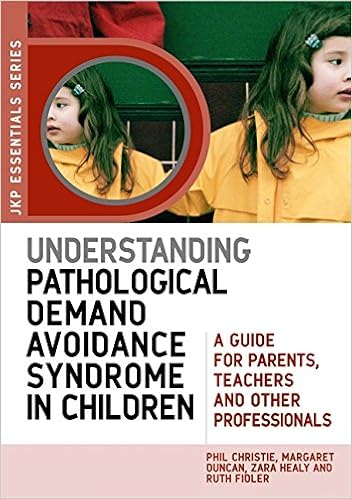
I love the ideas and activities  in Understanding Pathological Demand Avoidance Syndrome in Children: A Guide for Parents, Teachers and Other Professionals 
by Phil Christie ,‎ Margaret Duncan ,‎ Ruth Fidler ,‎ Zara Healy. If you work with someone similar to F, I'd highly recommend this book.


Thursday, 28 December 2017

What should I expect for my child's language development?


We like these guidelines:

AGE
Comprehension
Expression
Use of Language
18 months
Points to familiar and common objects on re quest
Understands  simple commands (e.g. Pick it up, fetch your shoes)
Uses at least 10 words meaningfully
Attempts imitation of  words and short phrases
Chatters nonsense to self with wide range of different sounds and intonations
Responds to other people e.g. answering questions
2 years
Shows body parts on request
Associates 2 nouns in a simple command (e.g. put the paper in the bin)
Spontaneous use of approx 50 words which can be understood by familiar adults
Starts conversations with others
2 1/5 years
 Understands simple short stories and conversations
Follows simple stories with  pictures
Combines 3 words
Begins to ask questions, use negatives and adjectives
Participates in  rhymes and songs
Carries on conversation for several turns
Responds to other peoples conversation


3 years
Selects objects pictures in relation to verb (which one do we wear?)
Understands common prepositions (in, on, under, behind)
4 to 5 word sentences which are intelligible to most people
Using plurals and past tenses, not always correctly
Asking what, where, who questions

4 years
Gives solutions to situations (what do you do when you are cold),
Identifies some colours, comparatives and superlatives (big, bigger, biggest)
Uses complete sentences
Asks ‘why’, ‘when’ and sometimes ‘how
Relates stories and simple sequences of events’
Enjoys jokes
Talks about own experiences
Assume adult  shares their knowledge 
5 Years
Follows a simple story without pictures
Asks meaning of abstract words
Size, shape, colour, quantity and position words used as aids to reasoning and understanding

Mastering irregular nouns and verbs (mice, men, drank, say)


if you are concerned please get in touch www.private-speech-therapy.co.uk


What is normal speech development?


I'm always being asked what is normal or typical for speech development. This is the best guide I have found:

Normal Speech Development

2 ½ - 3 years
Sounds used
Sounds emerging
M n

P b t d k g


f  s
W y h


3 – 4 years
Sounds used
Sounds emerging
M n

P b t d k g

F s
‘Sh’  v  z l  ‘ch’  j
W y h


 4 - 5 years
Sounds used
Sounds emerging
M n

P b t d k g

F v s z ‘sh’  ‘ch’ j
Th  r
W l y h


Sp, st, sk, bl, pl, gr

These are based on developmental norms for English (Elks & McLachlan)

If you are worried, please get in touch www.private-speech-therapy.co.uk